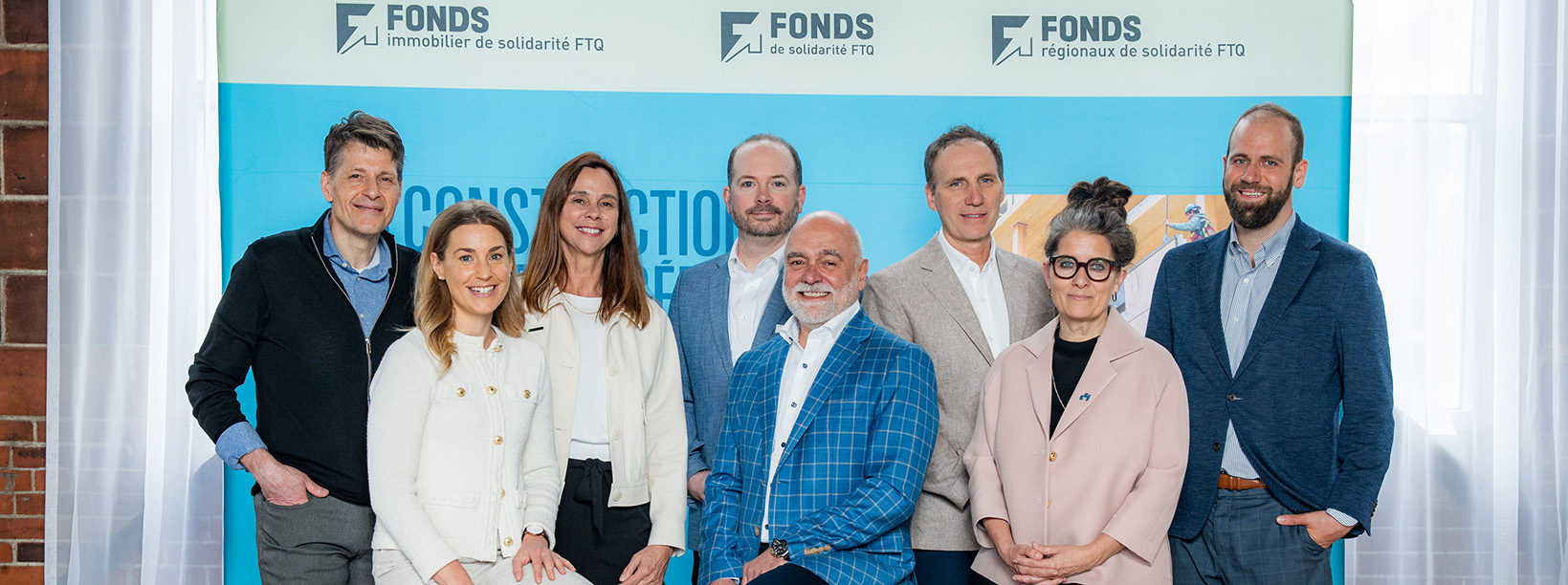


"RBQ is here to support the industry, and its new guidelines are part of the solution to accelerate the delivery of residential projects in sustainable real estate in Québec. This reform should spark renewed interest in encapsulated lumber, which is already widely used for tall structures in Ontario and British Columbia."
– Serge Cormier, Vice President, Value Creation, Sustainable Real Estate and Construction, Fonds immobilier de solidarité FTQ
The RBQ announcement paves the way for high-rise rental projects in mass timber across Québec. The first initiative by the Fonds immobilier de solidarité FTQ broke ground in spring 2026 in Terrebonne, featuring a first building made of mass timber with over 150 rental apartments. The goal is to develop a scalable model that will support future advancements in mass timber construction standards in Québec. This project aligns with the Fonds de solidarité FTQ's strategic vision to reach $12 billion in sustainable development assets by 2027 and represents another step toward decarbonizing the Fonds immobilier de solidarité FTQ's portfolio.
Check out LinkedIn posts by Serge Cormier, VP Value Creation, Sustainable Real Estate and Construction, and Martin Raymond, President and CEO, for more details on the Fonds immobilier de solidarité FTQ's first high-rise mass timber project (in French only).
The benefits of mass timber construction are ecological, technical, and commercial. This was the theme of the second edition of our Bâtir durable conference series, where experts featured in the article below helped debunk myths behind perceived risks among many investors. Here are 9 strong arguments in favor of mass timber construction that should interest real estate developers, architects, engineers, project owners, and business leaders.
Ecological Advantages
1. Carbon sequesters
Each cubic meter of wood used in a building sequesters about one ton of CO₂ while avoiding emissions associated with steel or concrete.
2. GHG Reduction
Using mass timber instead of concrete or steel in equivalent structures reduces embodied emissions (production emissions) by about 25–30% or more in some cases.
3. Favorable Life Cycle and End-of-Life
Wood is renewable, recyclable, or reusable at the end of its life. Wood construction waste can be repurposed, reducing landfill.
Watch these videos (in French only) to learn more about ecological benefits:
La construction en bois au Québec : d'hier à demain– Louis Poliquin, Director, Cecobois
La gestion durable des forêts
– André Gravel, President and CEO, Gestion Solifor
Technical Advantages
4. Superior Thermal Insulation
Mass timber is up to 10 times more insulating than concrete and about 350 times more insulating than steel in terms of heat loss.
5. Structural Strength and Safety
Although lighter, modern species and engineered wood (glulam, CLT, dowel-laminated, etc.) offer excellent compression and tension performance. Mass timber also performs very well in fire resistance.
6. Lightness, Prefabrication, and Speed of Construction
Compared to concrete or steel, mass timber is lighter, reducing foundation loads and simplifying transport and on-site assembly. It is well-suited for industrialized construction (factory prefabrication and on-site assembly).
7. Durability and Maintenance
When properly designed (moisture protection, appropriate treatment), mass timber has a long lifespan. Modern machining, preventive treatment, and maintenance practices minimize cracking, warping, or degradation.
Watch these videos (in French only) to learn more about technical benefits:
L'impact de la recherche et de l'innovation sur l'utilisation du bois en construction
– Sylvain Gagnon, gestionnaire, FPInnovations
Faciliter la construction en bois au Québec
– Silvia Garcia, vice-présidente, réglementation et innovation, Régie du bâtiment du Québec (RBQ)
Commercial Advantages
8. Market Appeal
Resilient buildings using sustainable materials like mass timber are increasingly sought after, enabling higher rents or better resale value.
9. Potential Savings for Occupants
Beyond its material quality, mass timber's natural insulation properties translate into lower heating and cooling costs compared to traditional buildings. Occupants benefit from energy savings, which can support full occupancy and lease renewals.
Watch this video (in French only) to learn more about commercial benefits:
Les perspectives du marché de la construction en bois massif et ses conditions de succès au Québec (panel discussion)
Building greener is absolutely achievable. The Fonds immobilier de solidarité FTQ is here to help you explore new possibilities for mass timber in residential construction.