


Large construction projects are changing the way waste is managed. Materials once viewed as waste are increasingly recognized as valuable resources. Recycling, reuse and repurposing are helping make construction projects more responsible, more efficient and better aligned with the economic and environmental realities facing the industry. Making this happen, however, requires collaboration.
"We are taking an important step by moving the circular economy beyond good intentions and into concrete decision-making. Building differently is possible—and increasingly necessary." — Martin Raymond, President and CEO, Fonds immobilier de solidarité FTQ
Recovering construction, renovation and demolition (CRD) materials requires time, space and careful planning to sort, process and maximize their value. Residual materials can often be given a second life instead of being discarded or sent to landfill. Some can even be resold. That is the essence of the circular economy.
Across the construction industry, circular practices are gaining momentum. Material reuse—giving existing materials a new purpose without reprocessing them—is one example. A market for recovered materials is taking shape, turning what was once considered waste into valuable resources. Likewise, repurposing and preserving existing buildings can revitalize places with architectural or historical significance. The potential is enormous—and remarkable architectural projects are already demonstrating what is possible.
Capture value from overlooked materials
Concrete, for example, can be reused as backfill. Brick and other materials recovered through deconstruction can be processed and returned to market. Rather than ending up in landfill, valuable materials can continue generating economic value.
Creating a viable market, however, will take time. Demand for some recovered materials remains limited, while others are difficult to extract or prepare for resale. Reuse networks also need greater capacity to handle larger volumes. Until both supply and demand grow together, too much material will continue to end up in landfill. Breaking that cycle will require action across the industry.
A list of sorting centres is available on the RECYC-QUÉBEC website..
Strengthen circularity through policy and incentives
The foundations of a circular economy are beginning to take shape. Successful initiatives are demonstrating what is possible, and the industry is ready to move forward. But it cannot do so without the right policy framework, tools and market signals.
On the policy front, governments are expected to introduce higher landfill fees for construction waste in the near future to encourage waste reduction. On the operational side, more rigorous on-site sorting could generate substantial savings.
Ultimately, financial incentives, stronger regulatory measures and traceability mechanisms would help divert more materials from landfill to recovery streams. As long as landfill remains the simplest—and often the least expensive—option, it will continue to be the default choice.
Align environmental and financial performance
The data are compelling. Construction, renovation and demolition account for 42% of global greenhouse gas emissions.[1] In Québec, more than 25% of all discarded materials originate from large construction sites[2]. Studies also suggest that up to 30% of construction materials delivered to a site are never used[3]. Compared with new construction, repurposing an existing building can reduce its overall environmental impact by approximately 40%, and by as much as 75% on some projects[4].
Environmental and financial performance are not competing objectives—they go hand in hand. In other words, sustainability creates value. According to the Sustainable Real Estate White Paper, commissioned by Decarbone+, buildings that perform well from an energy, climate and operational perspective are more resilient and financially stable.
Plan for circularity from the outset
Implementing a material reuse or residual materials management program is not always straightforward. The key is to plan ahead: develop an action plan, train project teams and invest in the right equipment. Although planning takes time and resources, it makes implementation easier—and ultimately more cost-effective.
Careful sorting is the first step toward maximizing material value. Greater value can be created earlier still by selecting durable, high-quality materials at the design stage so they can be recovered or reused at the end of a building’s life instead of being discarded. This is where life-cycle assessment (LCA) and design for deconstruction come into play.
Build through collaboration
Individual initiatives can make a difference, but their impact is greatest when they are part of a collective effort.
To avoid unnecessary economic losses, reduce the waste of materials that have already been purchased, extracted and processed, and minimize environmental impacts, the industry must build more responsibly and manage projects more effectively.
Real progress begins with recognizing the financial value of sustainable practices. Advancing the circular economy will require collaboration across the entire construction value chain—from designers and manufacturers to developers, contractors, suppliers and tradespeople.
The fourth edition of the Bâtir durable series explored the theme Residual materials: Waste or value creation? Hosted by the Fonds immobilier de solidarité FTQ, the event brought together about 10 speakers active in recycling, reuse and building repurposing, along with nearly 100 participants interested in these approaches. Watch our speakers discuss recycling, reuse and building repurposing. (in French)
Fonds immobilier speakers included :
They were joined by experts whose insights helped spark discussion on how the construction industry can build the knowledge and expertise needed to advance more sustainable practices:
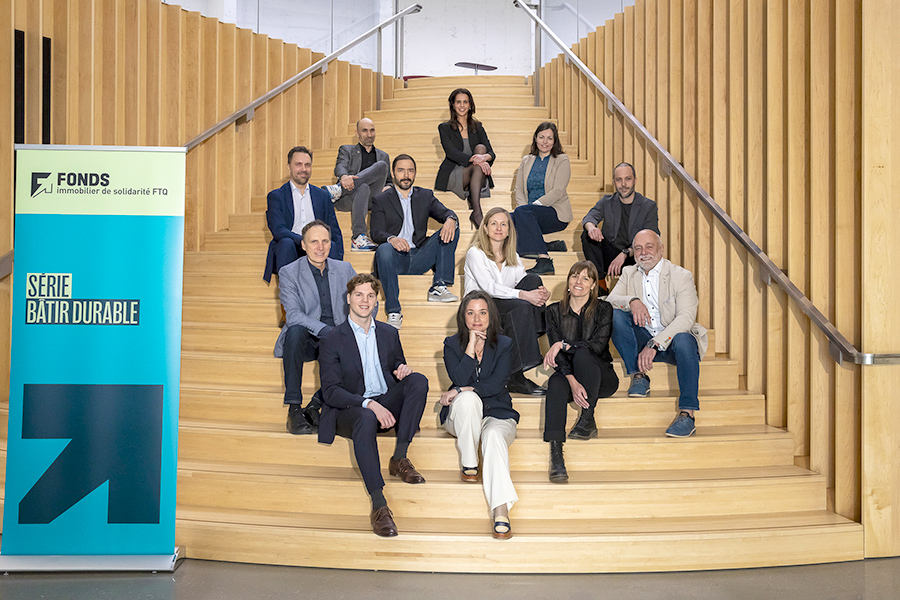
Recycling, reuse and repurposing are more than concepts. They are practical solutions for optimizing residual materials management on large construction projects. The Fonds immobilier de solidarité FTQ works with developers and builders to implement greener, more sustainable practices. We welcome your ideas, your experience and your feedback as we continue working together to advance the industry.
1 GRESB, What is embodied carbon in the real estate sector and why does it matter?, January 29, 2026.
2 RecycQuébec Gouvernement du Québec : 15e Bilan de la gestion des matières résiduelles au Québec : Les efforts de la population portent fruit Gouvernement du Québec, 17 juin 2025.
3 APCHQ, Économie circulaire Projet de Feuille de route montréalaise en économie circulaire, 26 avril 2023 citant BigRentz, 23 construction waste statistics & tips to reduce landfill debris, 2021.
4 Hasik et al., - Comparative whole-building life cycle assessment of renovation and new construction, Hasik and al, 2019, www.scilit.com.
