
Fonds immobilier de solidarité FTQ accelerates completion of Hauban mass timber project
A pioneering project to move Québec real estate forward


Terrebonne, November 19, 2026
The Fonds immobilier de solidarité FTQ has moved up completion of Hauban, its mass timber rental housing development in Terrebonne, from spring 2028 to fall 2027. The accelerated timeline is the result of several Québec innovations showcased during a tour of the construction site. It was announced that Hauban has achieved Zero Carbon Building – Design (ZCB-Design v3) certification from the Canada Green Building Council (CAGBC).
Located at 600 Lucille-Teasdale Boulevard, the 12-storey building will feature 164 apartments. It will be Québec's first high-rise mass timber building designed specifically for rental housing. The project also aims to demonstrate how housing can be built faster, with a smaller environmental footprint, using methods that can be replicated to help address the housing shortage.
"With Hauban, we're doing more than constructing a building. We're developing an innovative model that could be replicated across Québec to deliver housing faster while reducing the construction industry's environmental footprint," said Janie C. Béïque, President and CEO of the Fonds de solidarité FTQ.
Meaning ‘guy wire,' the name Hauban evokes strength and resilience. It also reflects the Fonds' commitment to innovative construction that combines environmental performance with quality of life for future residents.
Building faster through innovation
The accelerated construction schedule is made possible in part by a prefabricated mass timber structure, the off-site production of building components and Upbrella, a Québec-developed system that encloses the active construction area.
With more than 50% of the building's components prefabricated, including the structure, façade panels and various mechanical and electrical components, Hauban is reducing both construction time and material waste.
Used for the first time in North America on a high-rise mass timber residential project of this scale, the Upbrella system protects materials during construction, minimizes weather-related delays, improves worksite safety and streamlines construction.
"Each lesson learned from Hauban brings us closer to a more efficient, replicable construction model. Our goal is to document the results so the industry can benefit from what we learn," said Martin Raymond, President and CEO of the Fonds immobilier de solidarité FTQ.
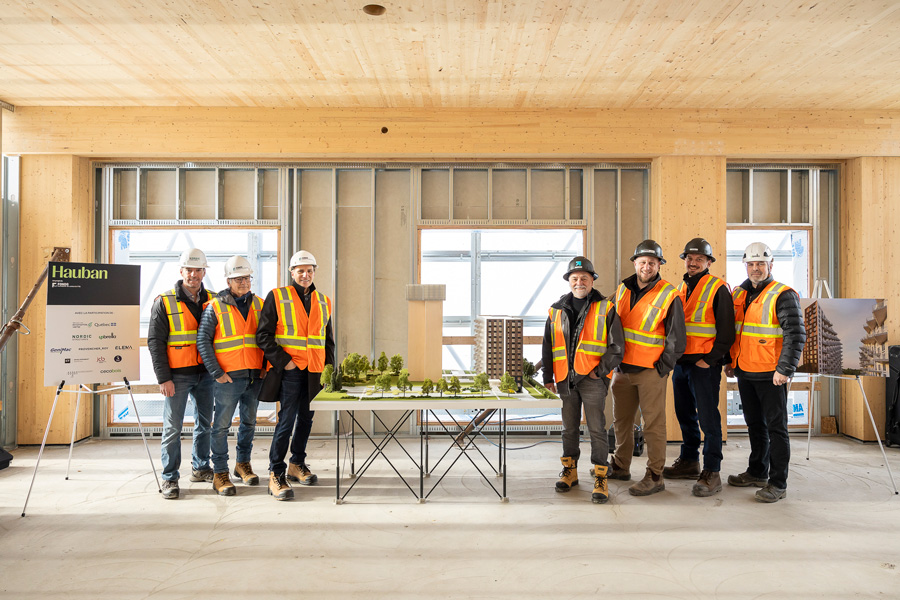
From left to right: Frédéric Verreault, Vice-President, Corporate Affairs, Chantiers Chibougamau; Claude Bergeron, Chair of the Board of Directors, Fonds immobilier de solidarité FTQ; Martin Raymond, President and Chief Executive Officer, Fonds immobilier de solidarité FTQ; Serge Cormier, Vice-President, Value Creation, Sustainable Real Estate and Construction, Fonds immobilier de solidarité FTQ; Simon-Jacques Leclerc, Senior Director, Construction, Fonds immobilier de solidarité FTQ; Frédéric Tremblay, Director, Real Estate Investments, ESG and Value Creation; Joey Larouche, President, Upbrella. Photo credit: Louis-Étienne Doré
Building with Québec mass timber
Hauban's mass timber structure is manufactured in Québec by Chantiers Chibougamau, a Fonds de solidarité FTQ partner since 2011, whose Nordic Structures division is overseeing construction. Using Québec-made mass timber reduces construction-related carbon emissions, supports the province's forest products industry and broadens the range of construction methods available to address the housing shortage.
Hauban is targeting the Canada Green Building Council's Zero Carbon Building – Design certification. From the design stage, the project has incorporated measures to improve energy efficiency, promote material reuse and reduce embodied carbon.
Long-term ambition
Wholly owned by the Fonds immobilier de solidarité FTQ, Hauban will help identify and document what is needed to replicate this sustainable construction model on a larger scale.
"The accelerated schedule is the result of several mutually reinforcing innovations. Hauban also gives us an opportunity to demonstrate that high-rise mass timber buildings can meet rigorous quality, safety and performance standards while providing valuable insights for future projects across Québec," said Serge Cormier, Vice-President, Value Creation, Sustainable Real Estate and Construction, at the Fonds immobilier de solidarité FTQ.
Designed as a pioneering project, Hauban will provide an opportunity to measure, document and share lessons learned from the design and construction of high-rise mass timber residential buildings. The goal is to establish a replicable model that could accelerate the delivery of sustainable housing across Québec.
Hauban at a glance
- 164 rental apartments
- 12-storey mass timber building
- 600 Lucille-Teasdale Boulevard, Terrebonne
- High-rise mass timber rental building
- Units ranging from studios to three-bedroom apartments
- First apartments scheduled for occupancy in fall 2027
- Leasing office scheduled to open in winter 2027
- Target certification: Zero Carbon Building – Design
Hauban is being developed by the Fonds immobilier de solidarité FTQ. The project has also received financial assistance of up to $2.9 million through the Québec government's Programme d'innovation en construction bois (wood construction innovation program), administered by the Ministère des Ressources naturelles et des Forêts. The program is funded under the 2030 Plan for a Green Economy and Québec's Carbon Market.
Link to visuals, fact sheet and video
About the Fonds de solidarité FTQ
A source of pride for Quebecers, the Fonds de solidarité FTQ fulfills its mission through a unique business model created more than 40 years ago. Since then, the Fonds has mobilized and engaged Québec by leveraging the retirement savings of more than 828,000 shareholders- savers.
With net assets totalling $23.7 billion as of May 31, 2026, the Fonds supports thousands of companies through direct and indirect venture and growth investments, guided by the belief that its investments generate both financial and societal impact. In fiscal 2025–2026, the Fonds and its local, regional and real estate networks invested $1.9 billion in Québec's economy. For more information, visit LinkedIn.
About the Fonds immobilier de solidarité FTQ
The Fonds immobilier de solidarité FTQ contributes to Québec's economic development by strategically investing alongside industry leaders in profitable real estate projects. It backs mixed-use developments that combine residential, retail and office components, as well as industrial projects, with a strong focus on sustainable development. As at June 30, 2026, the Fonds immobilier had 26 projects in development or under construction valued at $4.2 billion, including nearly 5,200 residential units under construction, and 84 operating assets totalling 7,418 residential rental units. The Fonds immobilier is a member of Bâtiment durable Québec.
